

Mill Optimisation

Importance of Milling
Influence on Mill Performance on Combustion and Boiler Performance
Milling performance is critical in controlling the combustion process in the boiler.
Coal pf fineness influences:
- ignition delay;
- combustion efficiency;
- particle erosion;
- loss on ignition (and hence coal costs);
- value of ash and ability to dispose / sell;
- emission levels;
- boiler slagging and fouling;
- potential damage to superheater tubes from combustion delay.
Need for Testing
- Mill maintenance costs are one of the highest maintenance costs in a coal fired power station;
- Testing allows a change to 'condition based' maintenance (from set mill operating hours) which in HRL's experience can increase time between minor / major mill overhauls by up to 10%;
- Optimising milling performance can reduce coal consumption and therefore costs;
- Testing can help detect mill performance issues early and can help direct / target maintenance activity.
Broader HRL Mill Performance Capability
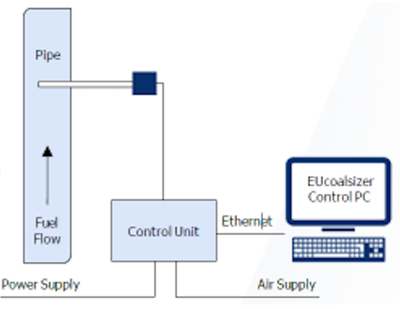
The EUcoalsizer fits into the broader mill performance service offer to assist in optimising mill performance.
- Measurement of pf flow per burner duct microwave technology;
- Coal flow balancing (e.g. by adjustment of values on PF pipes);
- Check / calibration of coal flow obtained from volumetric or gravimetric coal feeder to mill and check on mill capacity limits (and assessment of reason for limits);
- Mill power consumption (per unit of coal throughput) including as a check on classifier recirculation rates;
- CFD modelling of milling system to solve flow related issues;
- Adjustment of classier vane setting or redesign to adjust pf fineness;
- Mill condition and inspection;
- Measurement of pressure drop across mill / classifier;
- Mill performance as a function of load / coal throughput;
- Measurement of PA flow / auxiliary air / mill seal air flowrate;
- Comparison of measurements against station instruments;
- 'Clean' (no coal flow) testing to measure air flow distribution to burners;
- Assessment of individual mill performance and recommendations for maintenance, physical modifications, or operational changes;
- Measurement of mill inlet / outlet temperature, and check on temperature stability;
- Testing of mill performance following major overhaul to demonstrate performance gain and to help optimise future overhaul scope of work;
- Assessment of materials, failure analysis, requirement for repair or replacement.
Introducing the EUcoalsizer
EUcoalsizer Features
- Measures (in real time) pf particle size distribution (PSD), coal and air flow;
- Provides spatially resolved (2D) readings;
- Allows real time coal : air flow tuning and adjustment of coal feeders / mill control settings;
- Requires larger 3" ports to be installed.
Benefits of EUcoalsizer
- Cost of testing is dramatically reduced. Testing is conducted by a single operator;
- The cost competitiveness allows regular e.g. quarterly or bi-annual testing of all mills;
- This in turn facilitates moving to a 'condition based' maintenance program and hence a reduction in mill maintenance cost, as well as prioritising mill maintenance to optimise combustion performance;
- Allows milling performance to be characterised following a change in coal supply (or evaluation of suitability of a particular coal supply);
- Allows real-time assessment of changes to mill operation and settings on pf size and hence adoption
- of a mill operation optimisation program;
- Optimising mill performance can result in reduction in coal consumption, carbon in ash and allows full benefit to be obtained from combustion tuning.